A Complete Guide to Small Business Tax in Canada
Small business tax in Canada covers corporate income tax, GST/HST obligations, payroll deductions, and provincial tax requirements that every business owner must understand and manage correctly. The federal small business tax rate is 9% on the first $500,000 of active business income for Canadian-controlled private corporations, making Canada one of the more competitive environments for small business taxation globally. Whether you operate as a sole proprietor, partnership, or corporation, your tax obligations depend on your business structure, your province, and your annual revenue.
This guide covers everything you need to know about small business tax in Canada from structure to filing to deductions.

Understanding Business Structures and How They Affect Tax
The first and most important tax decision any Canadian small business owner makes is choosing the right business structure. Your structure determines which tax rules apply to you, how your income is reported, and what rates you pay.
1. Sole Proprietorship
A sole proprietor reports business income directly on their personal T1 tax return using a T2125 Statement of Business or Professional Activities. The net business income is added to any other personal income and taxed at the individual’s marginal rate. There is no corporate tax, no separate business return, and no small business deduction available. For lower-income businesses, this simplicity can be an advantage. For higher-income individuals, the marginal personal tax rates, which can exceed 50 percent in some provinces, make incorporation worth serious consideration.
2. Partnership
A partnership works similarly to a sole proprietorship for tax purposes. Each partner reports their share of the partnership’s income or loss on their own personal tax return. The partnership itself does not pay income tax, but it must file an annual T5013 Partnership Information Return if certain thresholds are met. Partners are taxed at their individual marginal rates on their respective shares of income.
3. Corporation
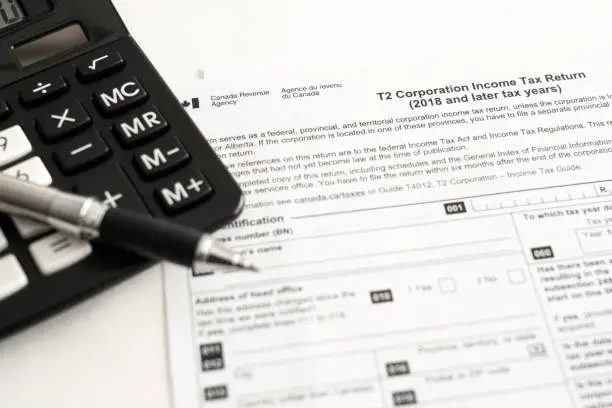
A Canadian-controlled private corporation (CCPC) is taxed as a separate legal entity. Corporate income is reported on a T2 Corporation Income Tax Return filed with the CRA. The federal small business tax rate of 9% applies to the first $500,000 of active business income annually under the small business deduction. Income above $500,000 is taxed at the general corporate rate of 15% federally. Provinces also levy their own corporate income tax on top of the federal rate, so the combined rate varies by province.
Federal Small Business Tax Rates in Canada
The federal tax framework for small businesses in Canada is built around the small business deduction, which reduces the federal corporate tax rate from 15% down to 9% for CCPCs earning up to $500,000 in active business income per year. This $500,000 limit is known as the business limit.
The business limit begins to phase out when a CCPC’s taxable capital employed in Canada exceeds $10 million and is eliminated entirely at $50 million. Businesses with significant capital assets need to monitor this threshold carefully because losing the small business deduction significantly increases their effective tax rate.
Passive investment income also affects the small business deduction. When a CCPC earns more than $50,000 in passive investment income in a year, the business limit is reduced. At $150,000 in passive income, the small business deduction is eliminated entirely for that year. This is an important planning consideration for business owners who hold investments inside their corporation.
Provincial Small Business Tax Rates Across Canada
Every province and territory in Canada levies its own corporate income tax on top of the federal rate. The combined federal and provincial rate that applies to small business income varies significantly by province.
| Province | Provincial Small Business Rate | Combined Rate (Federal + Provincial) |
|---|---|---|
| Ontario | 3.2% | 12.2% |
| Alberta | 2% | 11% |
| British Columbia | 2% | 11% |
| Quebec | 3.2% | 12.2% |
| Saskatchewan | 1% | 10% |
| Manitoba | 0% | 9% |
| New Brunswick | 2.5% | 11.5% |
| Nova Scotia | 2.5% | 11.5% |
| PEI | 1% | 10% |
| Newfoundland | 3% | 12% |
Alberta and BC both offer a 2% provincial small business rate, making them two of the more tax-efficient provinces for incorporated small businesses. Alberta’s overall business environment is further strengthened by the absence of a provincial sales tax, which reduces compliance costs for businesses that sell taxable goods and services.
GST/HST Obligations for Small Businesses
Every small business in Canada with taxable revenues above $30,000 in any single calendar quarter or over four consecutive quarters must register for GST or HST with the CRA. Once registered, the business collects tax on taxable sales and remits it to the CRA on a monthly, quarterly, or annual schedule based on revenue volume.
Registered businesses can claim Input Tax Credits to recover the GST/HST paid on eligible business purchases and expenses. For businesses with significant operating costs, ITCs can result in a net GST/HST refund from the CRA rather than a balance owing. This is one of the most valuable and often overlooked benefits of GST/HST registration for small businesses
Understanding which goods and services are taxable, which are zero-rated, and which are exempt is an important part of managing small business tax in Canada correctly. Filing errors in this area are among the most common issues flagged in our guide on tax mistakes small businesses make, which covers the full list of avoidable compliance errors that cost Canadian business owners money every year.

Tax Deductions Available to Canadian Small Businesses
One of the most powerful tools for reducing small business tax in Canada is maximizing the deductions available to your business. The CRA allows businesses to deduct expenses that are reasonable and incurred for the purpose of earning business income.
Common deductible expenses include office rent or home office costs, employee salaries and wages, professional fees for accounting and legal services, advertising and marketing costs, business travel and vehicle expenses, computer equipment and software, and business insurance premiums.
The details of what qualifies, how much can be deducted, and how mixed-use expenses are treated are covered in depth in our complete resource on tax deductions for small businesses, which gives Canadian business owners a full breakdown of every category of deductible expense available under the CRA’s rules.
Corporate Tax Filing Deadlines for Small Businesses
Canadian corporations must file their T2 corporate income tax return within six months of their fiscal year end. However, any tax owing must be paid within two months of the fiscal year end for most corporations, or three months for CCPCs that meet certain conditions.
For a corporation with a December 31 fiscal year end, the tax payment deadline is February 28 and the filing deadline is June 30. Missing the payment deadline results in interest charges on the outstanding balance. Missing the filing deadline adds late filing penalties on top of the interest.
Sole proprietors and partners report business income on their personal T1 tax return, which is due by June 15 for self-employed individuals. However, any balance owing on the T1 return must be paid by April 30 to avoid interest. This split deadline catches many sole proprietors off guard every year.

The Importance of Bookkeeping for Small Business Tax
Accurate bookkeeping is the foundation of every good small business tax outcome. Without organized, up-to-date financial records, it is impossible to calculate income correctly, claim all available deductions, or file accurate returns with the CRA. Good bookkeeping throughout the year also makes tax time significantly less stressful and less expensive. When your records are complete and organized, your accountant or tax preparer spends less time reconstructing transactions and more time identifying opportunities to reduce your tax liability.
Our bookkeeping checklist for small businesses covers everything a Canadian business needs throughout the year, including tracking income and expenses, reconciling accounts, and organizing receipts to ensure every deduction is captured and nothing is missed at filing time.. For small businesses that want to manage their own books, having the right software also makes a significant difference. Our guide on the best accounting software for small businesses reviews the top tools used by Canadian business owners and what each one offers in terms of GST/HST tracking, payroll integration, and CRA filing compatibility.
Conclusion
Small business tax in Canada is manageable when you understand the rules that apply to your business structure, your province, and your revenue level. The federal 9% small business tax rate is one of the most competitive in the world for incorporated businesses, but accessing it requires proper setup, accurate filing, and consistent compliance throughout the year. From choosing the right structure to claiming every available deduction, meeting filing deadlines, and keeping accurate books, every part of the tax picture connects.
Our team at Tax Return Filers provides Corporate Tax Returns in Toronto, GST/HST Filing in Toronto, Payroll Service in Brampton and Mississauga Bookkeeping services to help Canadian small businesses stay fully compliant, minimize their tax liability, and never miss a deadline.
FAQs
Book a Free Meeting with Our Tax Experts
Take the first step toward better tax planning with a free consultation. Our team is ready to review your situation and provide clear guidance. Book a time slot directly on our calendar and we will connect with you shortly.