Line 10100 vs Line 15000: What’s the Difference?
When you file your Canadian tax return, two lines cause the most confusion, Line 10100 and Line 15000. Here is the direct answer: Line 10100 reports only your employment income, while Line 15000 covers your total income from all sources combined. One feeds into the other. A clear understanding of how they differ is essential to file correctly and avoid costly mistakes.
An error on either of these lines can trigger a CRA reassessment, delay your refund, or affect your eligibility for key government benefits.

What Is Line 10100 on Your Tax Return?
Line 10100 on your tax return is specifically for employment income. This is the income you earned as an employee, reported by your employer on a T4 slip. The amount comes directly from Box 14 of your T4. If you worked more than one job during the year and received multiple T4 slips, you add all Box 14 amounts together and report the combined total on Line 10100.
This line captures nothing beyond employment income. It does not include self-employment earnings, rental income, pension payments, investment income, or government benefits. It is a focused, specific line with one job, to capture what you were paid as an employee.
What Is Line 15000 on Your Tax Return?
Line 15000 is your total income. It is the sum of all income you earned from every source during the tax year. Think of it as the big picture number, the one that shows the Canada Revenue Agency (CRA) everything you brought in before any deductions are applied.
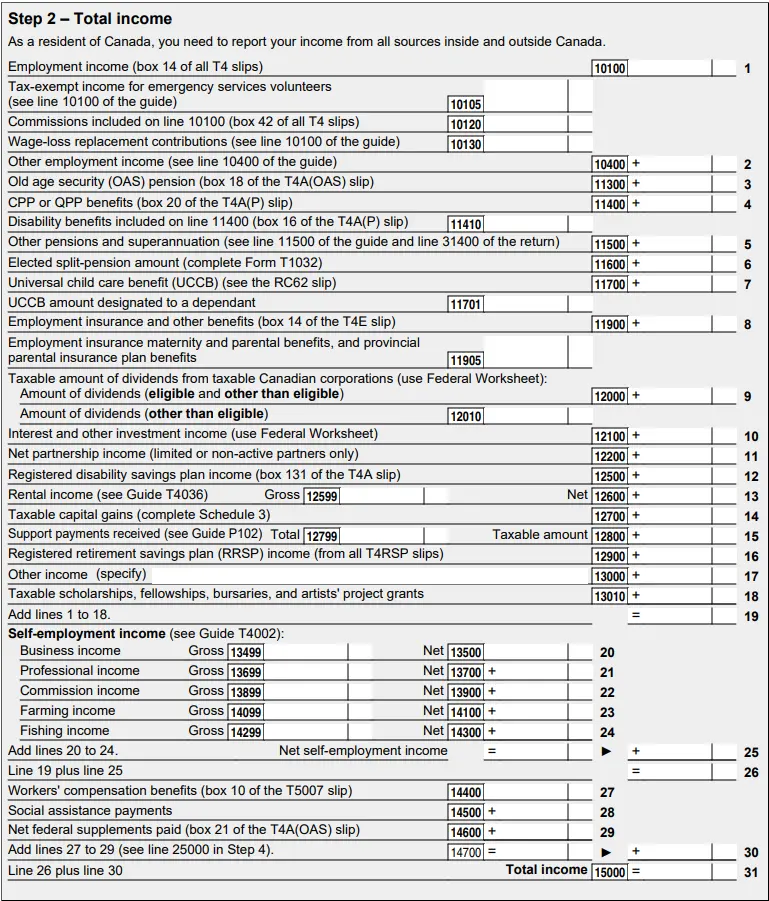
Line 15000 pulls together amounts from many lines above it on your T1 return, including employment income from Line 10100, self-employment income, rental income, pension and RRSP income, EI benefits, investment income, and other taxable income sources. You do not manually calculate Line 15000 from scratch, your tax software or T1 form adds it up automatically based on all the income lines you have filled in above it.
Line 10100 vs Line 15000: Side-by-Side Comparison
This table breaks down the key differences clearly:
| Feature | Line 10100 | Line 15000 |
|---|---|---|
| What it represents | Employment income only | Total income from all sources |
| Source of data | Box 14 of T4 slip(s) | Sum of all income lines above it |
| Who it applies to | Employees with T4 slips | All tax filers |
| Includes self-employment? | No | Yes |
| Includes rental income? | No | Yes |
| Includes pension/RRSP? | No | Yes |
| Feeds into | Line 15000 | Net income calculation |
| Entered manually? | Yes | Calculated automatically |
As shown above, Line 10100 is a component that feeds into Line 15000. They are connected, but they serve different purposes.
How Line 10100 Feeds Into Line 15000
The relationship between these two lines is straightforward. Everything you enter on Line 10100 becomes part of the total that ends up on Line 15000. But Line 15000 is much broader. A person who only has a single salaried job may find that their Line 10100 and Line 15000 amounts are identical or very close. However, someone with a side business, a rental property, or pension income will see a noticeably higher Line 15000 than Line 10100.
For example, if you work a full-time job in Brampton and earn $65,000 in employment income, your Line 10100 shows $65,000. But if you also earned $10,000 from a rental unit and $5,000 in investment income, your Line 15000 would show $80,000. The CRA uses Line 15000 to assess your overall financial picture, while Line 10100 is just one piece of it.
Why Both Lines Matter for Your Tax Filing
Line 15000 is used in many important CRA calculations beyond just tax owing. It determines your eligibility for income-tested benefits like the GST/HST credit, Canada Child Benefit, and Old Age Security. It is also used by lenders, landlords, and government programs when assessing your financial standing. Entering incorrect amounts on either line causes ripple effects across your entire return.
Line 10100 on your tax return matters because errors here affect every calculation downstream. One of the most common 10100 mistakes is entering the wrong Box 14 amount, especially when a person has received multiple T4 slips and forgets to add them all together. If you had more than one employer during the year, make sure you understand how to handle multiple T4 slips correctly before entering anything on Line 10100.
What Goes Between Line 10100 and Line 15000?
Between these two lines, there are several other income lines on the T1 return. Each one captures a different income type. Common lines that sit between 10100 and 15000 include:
- Line 10400: Other employment income (tips, gratuities, foreign employment income)
- Line 11300: Old Age Security pension
- Line 11400: CPP or QPP benefits
- Line 11900: Employment Insurance benefits
- Line 12100: Interest and investment income
- Line 12600: Net rental income
- Line 13500: Self-employment business income
All of these flow upward and combine to produce your Line 15000 total. If any one of these lines is missed or entered incorrectly, your total income figure will be wrong, and the CRA will likely flag it.
Common Mistakes People Make With These Two Lines
Confusing what belongs on Line 10100 versus what belongs elsewhere is more common than you might think. Here are the most frequent mistakes filers make:
- Including freelance or contract income on Line 10100: This is incorrect. Self-employment income belongs on Line 13500, not Line 10100. Only income from a formal employer-employee relationship, confirmed by a T4 slip, goes on Line 10100.
- Treating Line 15000 as a manual entry: You do not enter a number there yourself. It is the result of adding up all the income lines above it. Overwriting this line or skipping income sources causes your Line 15000 to be understated, which is a serious issue with the CRA.
- Overlooking foreign income or partial-year earnings: Some filers miss income earned outside Canada or during a short employment period. All of it must be reported and included in Line 15000, regardless of where or when it was earned.
Get Professional Help With Your T1 Tax Return
Understanding the difference between Line 10100 and Line 15000 is just one part of filing your T1 return correctly. Professional tax preparation ensures every income source gets reported on the right line, all deductions are claimed, and your return processes smoothly without CRA reassessments.
Tax Return Filers PC prepares complete T1 returns for individuals across Canada. Alberta residents can rely on our Personal Income Tax Returns Services in Calgary for accurate employment income reporting, RRSP optimization, and electronic filing with direct deposit refunds. Ontario filers receive the same comprehensive support through our Personal Income Tax in Mississauga, including multi-source income reporting and year-round CRA correspondence assistance.
Working with experienced accountants means Line 10100, Line 15000, and every other line on your return gets completed correctly the first time.
Conclusion
Line 10100 and Line 15000 serve two distinct but connected roles on your Canadian tax return. Line 10100 captures your employment income from T4 slips. Line 15000 captures everything, it is the total income number the CRA and many benefit programs rely on. Errors on either line, whether from missing multiple T4 slips, entering the wrong box amount, or misclassifying income, can lead to reassessments and missed benefits.
If you want to file with accuracy and confidence, the team at Tax Return Filers Professional Corporation is here to make sure every line on your return is completed correctly the first time.
FAQs
Book a Free Meeting with Our Tax Experts
Take the first step toward better tax planning with a free consultation. Our team is ready to review your situation and provide clear guidance. Book a time slot directly on our calendar and we will connect with you shortly.