Form 8840: The Closer Connection Exception for Canadians
Form 8840 is the IRS form that allows Canadians to claim the Closer Connection Exception and avoid being treated as a US tax resident under the Substantial Presence Test. If you spent enough days in the United States to meet the IRS day count threshold but maintained stronger personal and economic ties to Canada, filing Form 8840 tells the IRS that your tax home remains in Canada. Without this form, the IRS can classify you as a US tax resident and require you to report your world income on a US tax return.
What Is the Closer Connection Exception?
The Closer Connection Exception is an IRS provision that overrides the Substantial Presence Test result when your ties to Canada are stronger than your ties to the US. The Substantial Presence Test uses a weighted formula across three calendar years. It counts all days in the current year, plus one third of the days from the prior year, plus one sixth of the days from two years back. If that total reaches 183, the IRS treats you as a US tax resident.
The IRS evaluates several factors to determine your closer connection. These include where your permanent home is located, where your family lives, where you keep your personal belongings such as furniture, clothing, and vehicles, where your bank accounts and investments are held, where your driver’s license was issued, where you are registered to vote, and which country you list as your residence on official forms and documents.
Canadian snowbirds who spend four to six months per year in the US are the most common filers of Form 8840. Retirees with winter homes in Florida, Arizona, or Texas often meet the Substantial Presence Test through their accumulated days but clearly maintain their primary life in Canada. The Closer Connection Exception exists specifically for situations like these.

Who Needs to File Form 8840?
You need to file Form 8840 if all three of these conditions are true: your weighted day count under the Substantial Presence Test reached 183 or more, you spent fewer than 183 actual days in the US during the current calendar year, and you maintained a closer connection to Canada than to the United States. If you spent 183 or more actual days in the US during the current year, the Closer Connection Exception does not apply and you cannot use Form 8840 to avoid US tax residency.
The form is also relevant for Canadians who are not sure if they crossed the threshold. If you travel between Canada and the US frequently for business, medical treatment, or family visits, your days can add up faster than expected. The IRS and CRA now share entry and exit records through a bilateral data exchange agreement. Your passport swipes at the border create an exact count, so relying on estimates puts you at risk.
Canadians who own rental property in the US, hold US investments, or operate a business with US clients should pay close attention to their day count. Even if your primary reason for visiting the US is personal, the IRS counts every day regardless of purpose.
How to Complete Form 8840?
The form is divided into several parts. Part I asks for your personal information, including your name, address, US taxpayer identification number (ITIN or SSN if you have one), and your country of citizenship. You do not need a US Social Security Number or ITIN to file Form 8840. If you do not have either, leave those fields blank and the IRS will process the form without them.
Part II asks you to list the number of days you were present in the US for the current year, the prior year, and two years back. These are actual days, not the weighted formula result. The IRS uses these numbers to verify that your weighted total meets the Substantial Presence Test threshold and that your current year actual days stayed below 183.
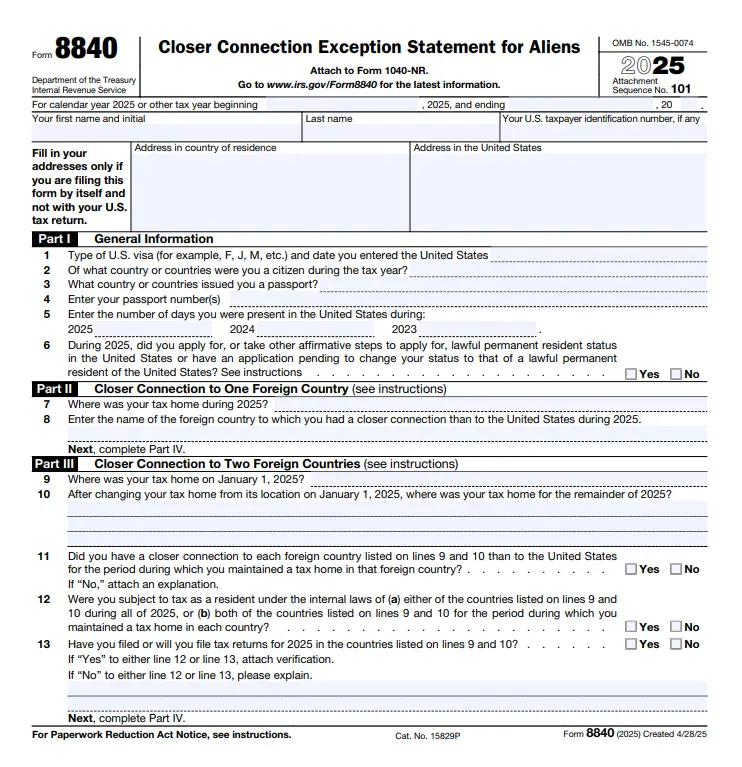
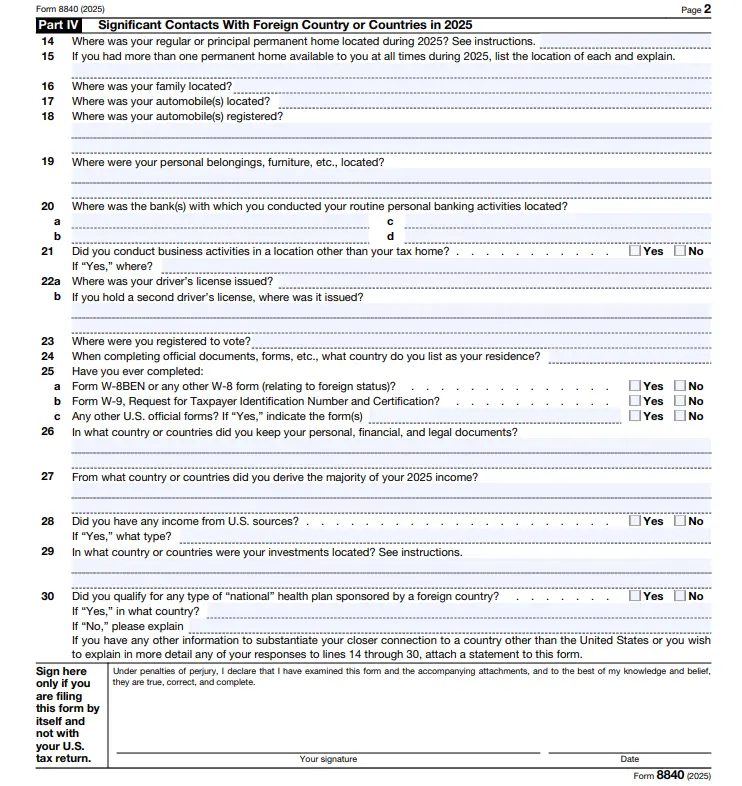
Part III is the core of the form. It asks you to identify your tax home country and provide details about your closer connection to Canada. You must list the location of your permanent home, your family connections, your personal property, your bank accounts, your driver’s license jurisdiction, where you vote, and any charitable or social organizations you belong to.
Part IV covers situations where you have a closer connection to two foreign countries instead of one. Most Canadian filers only deal with Part III.
When and Where to File Form 8840?
The filing deadline for Form 8840 matches the US tax return deadline for Canadians, which is June 15 of the following year. If your Substantial Presence Test applies to the 2024 tax year, your Form 8840 is due by June 15, 2025. You file the form by mailing it to the IRS address listed in the form instructions. There is no electronic filing option for Form 8840. The mailing address depends on your location, and the instructions specify the correct IRS office for Canadian filers.
Form 8840 is filed on its own. You do not need to attach it to a US tax return unless you have other US filing obligations, such as rental income from a US property or US source business income. If you have no US source income and your only reason for filing is to claim the Closer Connection Exception, Form 8840 is the only document you send to the IRS.
Late filing carries consequences. If you fail to file Form 8840 by the deadline, the IRS can deny the Closer Connection Exception and treat you as a US tax resident for the full year. That triggers a requirement to file a US tax return reporting your world income. Penalties for late filing of a US return start at 5 percent of unpaid tax per month, up to 25 percent, plus daily compounding interest.
Form 8840 vs Form 8833: Which One Do You Need
Form 8840 claims the Closer Connection Exception to avoid US tax residency entirely. If the IRS accepts your Form 8840, you are not a US tax resident and you do not need to file a US tax return (unless you have US source income that requires reporting on its own).
Form 8833 (Treaty-Based Return Position Disclosure) is different. You file Form 8833 when you are already considered a US tax resident under the Substantial Presence Test and you want to use the Canada US Tax Treaty tie-breaker rules to override that status. Form 8833 must be filed with a US tax return, typically Form 1040-NR.
The key difference is timing in the process. Form 8840 prevents US tax residency before it triggers. Form 8833 accepts that the test was triggered and uses the treaty to override the result. If your actual days in the US during the current year reached 183 or more, you cannot use Form 8840 and must rely on Form 8833 and the treaty instead.
Some Canadians file both forms in the same year if they have US source income that requires a tax return and also want to document their closer connection to Canada for the IRS record.
Common Mistakes Canadians Make with Form 8840
Most errors come from missed deadlines, poor documentation, and confusion about which days count.
- Not filing Form 8840 at all. Many Canadian snowbirds assume that keeping their Canadian passport and health card is enough to prove they are not US tax residents. It is not. The IRS requires the form as a formal declaration. Without it, passing the Substantial Presence Test automatically makes you a US tax resident in the eyes of the IRS.
- Filing late. Form 8840 must reach the IRS by June 15. There is no automatic extension for this form, and late filing gives the IRS grounds to reject your Closer Connection Exception even if you clearly qualify.
- Vague answers in Part III. Listing “Canada” as your tax home without supporting details weakens your claim. Specify the city and province where your home is located. Name the bank where your accounts are held. List your provincial health card, your Canadian driver’s license, your Canadian voter registration, and your memberships in Canadian organizations.
- Failing to track days accurately. Canadians who split time between their home in Toronto, Mississauga, Brampton, or Calgary and a winter property in the US need exact records. Every day or part of a day on US soil counts, including travel days. The CRA and IRS share border crossing data, so your records need to match what the governments already have.
Tax Return Filers PC helps Canadians across Toronto, Mississauga, Brampton, and Calgary manage their cross border tax filings, US tax accounting obligations, and non-resident tax filing so that both IRS and CRA compliance stays handled correctly. If you need help with Form 8840, the Substantial Presence Test calculation, or your departure tax return in Toronto, our cross-border team works through the filings from start to finish.
FAQs
Book a Free Meeting with Our Tax Experts
Take the first step toward better tax planning with a free consultation. Our team is ready to review your situation and provide clear guidance. Book a time slot directly on our calendar and we will connect with you shortly.