Home Office Expenses and the T2200: What Employees Can Claim
Home office expenses allow Canadian employees who work from home to deduct a portion of their household costs on their personal tax return. The CRA requires your employer to sign a T2200 (Declaration of Conditions of Employment) or a T2200S (short form) confirming that you were required to work from home as a condition of your job. Once you have a signed T2200, you can claim eligible expenses like rent, utilities, internet, and office supplies on your T1 return using Form T777.
The deduction reduces your taxable employment income, which lowers the amount of tax you owe for the year.
What Is the T2200 and Why You Need It?
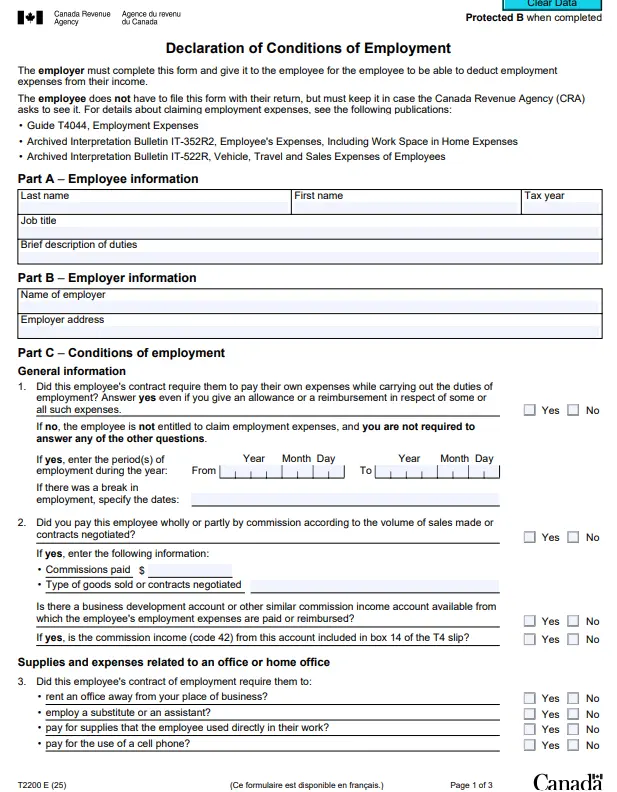
The T2200 is the CRA form your employer signs to confirm you were required to work from home as part of your employment contract. The T2200 (Declaration of Conditions of Employment) is not a tax slip like a T4 vs T4A vs T5. It is a supporting document that proves you met the CRA’s conditions for claiming home office expenses. Your employer fills out the form, signs it, and gives it to you. You do not file the T2200 with your tax return, but you must keep it on file in case the CRA asks for it during a review or audit.
The CRA will not accept home office expense claims without a completed T2200 or T2200S. If your employer refuses to sign the form, you cannot claim the deduction, even if you worked from home full time. The form confirms three things: that your employment contract required you to work from home, that your employer did not reimburse you for the expenses you are claiming, and that you paid the expenses yourself.
The T2200S is a shorter version of the form that the CRA introduced during the pandemic. It covers the same ground but with fewer questions. Either version satisfies the CRA requirement. Ask your employer which form they prefer to complete.

Which Home Office Expenses Can Employees Claim?
The CRA allows employees to claim a specific list of home office expenses, and the eligible items depend on whether you earn a salary or commission income.
Salaried employees can claim these home office expenses:
- Electricity, heat, and water
- Internet access fees (the portion used for work)
- Rent (if you rent your home)
- Minor maintenance and repair costs for the workspace
- Office supplies such as pens, paper, printer ink, and stamps
Commission employees can claim everything above plus:
- Home insurance premiums
- Property taxes
- Lease payments for a computer, cell phone, or other equipment required for work
Salaried employees cannot claim home insurance or property taxes. Commission employees can, because the CRA treats their income and expense structure differently under subsection 8(1)(f) of the Income Tax Act.
The T2200 also covers other employment expenses beyond the home office. If your employer requires you to use your personal vehicle for work, the same form supports a car allowance claim. Both deductions follow the same principle: your employer confirms the requirement, and you claim the expense on your T1 return. One expense that no employee can claim is mortgage interest or capital cost allowance (CCA) on the home. The CRA specifically excludes these from employment expense deductions.
How to Calculate Your Home Office Expense Deduction?
The CRA requires you to prorate your home office expenses based on the size of your workspace relative to your total home. The standard method uses floor area. Measure the square footage of your dedicated workspace and divide it by the total square footage of your home. If your home office is 150 square feet and your home is 1,500 square feet, your workspace represents 10 percent of the home. You can then claim 10 percent of your eligible household expenses.
If you share the workspace or do not use it exclusively for work, the CRA requires a second proration. Divide the number of hours you used the space for work by the total hours the space was available. If you worked 40 hours per week in a room that was available 168 hours per week (24 hours times 7 days), your usage rate is about 24 percent. Multiply this by the area percentage for your final claim rate.
Here is an example for a salaried employee in Toronto who rents an apartment:
| Expense | Annual Cost | Workspace % (10%) | Claimable Amount |
|---|---|---|---|
| Rent | $24,000 | 10% | $2,400 |
| Electricity | $1,800 | 10% | $180 |
| Internet | $1,200 | 10% | $120 |
| Heat | $1,400 | 10% | $140 |
| Office Supplies | $300 | 100% (direct) | $300 |
| Total Deduction | $3,140 |
Office supplies used entirely for work do not need to be prorated. You claim them at full cost. All other shared household expenses follow the workspace percentage.
How to File Home Office Expenses on Your Tax Return?
Home office expenses flow through Form T777 and land on line 22900 of your T1 return as employment expenses. To file using the detailed method, follow these steps. Gather your T2200 or T2200S signed by your employer. Collect all receipts for eligible expenses: rent payments, utility bills, internet invoices, and office supply receipts. Calculate your workspace percentage using the floor area method described above. Enter each expense on Form T777 (Statement of Employment Expenses) and apply your workspace percentage.
The total from Form T777 transfers to line 22900 of your T1 return, which reduces your net employment income. Your employment income on line 10100 stays the same, but your net income after the deduction drops. For a complete walkthrough of the T1 process, our step by step guide to personal tax returns in Canada covers every section of the return.
If you choose the flat rate method instead, you do not need Form T777 or a T2200. Simply claim $2 per day worked from home on line 22900, up to the $500 maximum. The CRA does not require receipts for the flat rate.
Keep all receipts and your signed T2200 for at least six years after filing. The CRA can request documentation at any point during that period to verify your claim. Home office expenses are one of the most valuable tax deductions you shouldn’t miss when filing your Canadian tax return, especially if you work from home more than a few days per week.
Common Mistakes Employees Make with Home Office Expenses
Most errors come from claiming ineligible expenses, skipping the T2200, or using the wrong calculation method.
- Claiming mortgage interest or CCA. Employees cannot deduct mortgage interest, principal payments, or capital cost allowance on their home. These are excluded from employment expense deductions entirely.
- Not getting the T2200 signed. If you use the detailed method without a signed T2200 or T2200S, the CRA will deny your claim during a review. Get the form signed before you file.
- Using the flat rate when the detailed method saves more. The flat rate caps at $500. An employee paying $2,000 per month in rent with a 10 percent workspace leaves $1,900 in deductions on the table by choosing the flat rate. Run both calculations before deciding.
- Claiming the full cost of shared expenses. Electricity, internet, and heat must be prorated by workspace percentage. Only office supplies purchased exclusively for work are claimed at full cost.
- Double claiming reimbursed expenses. If your employer reimbursed you for any portion of your home office costs, you cannot claim that same portion as a deduction. The T2200 asks your employer to confirm what was and was not reimbursed.
Tax Return Filers PC helps salaried and commission employees file their personal income tax returns in Toronto, Mississauga, Brampton, and Calgary with all employment deductions applied correctly, including home office expenses, T2200 documentation, payroll deductions in Canada, and CPP and EI rates adjustments.
FAQs
Book a Free Meeting with Our Tax Experts
Take the first step toward better tax planning with a free consultation. Our team is ready to review your situation and provide clear guidance. Book a time slot directly on our calendar and we will connect with you shortly.