How to File a T2 Corporation Income Tax Return in Canada?
Every Canadian corporation must file a T2 Corporation Income Tax Return with the CRA every year, regardless of whether the corporation earned income, had a loss, or was inactive during the tax year. The T2 return must be filed within six months of the corporation’s fiscal year end, and any tax owing must be paid within two or three months of year end depending on the corporation’s eligibility for the extended deadline. Filing the T2 correctly requires accurate financial statements, a completed T2 form, and all required schedules.
This step-by-step guide covers everything a Canadian corporation needs to know to file a T2 return accurately and on time.
What Is the T2 Corporate Tax Return?
The T2 is the official income tax return that every corporation incorporated or resident in Canada must file annually with the CRA. It reports the corporation’s total income, allowable deductions, taxable income, and the tax payable for the fiscal year. Unlike personal tax returns which are filed once per calendar year, T2 returns follow the corporation’s fiscal year end, which can fall on any date the corporation chooses.
A corporation with a March 31 fiscal year end files its T2 for the period ending March 31 each year, not December 31. This flexibility is one of the advantages of the corporate structure, as discussed in our guide on corporate tax vs personal tax in Canada which covers the key structural differences between how individuals and corporations are taxed.
Every Canadian corporation must file a T2 even if it had no income, no activity, or a tax loss for the year. A nil return still has a filing deadline and missing it still attracts a late filing penalty.
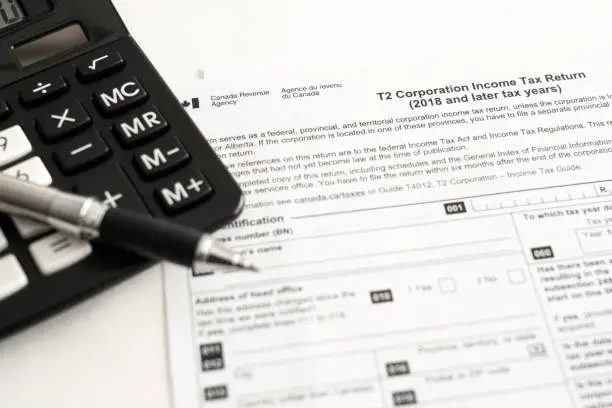
What You Need Before Filing a T2 Return?
Before starting the T2 filing process, a corporation must have its financial records fully prepared and reconciled for the fiscal year. Attempting to file without complete and accurate books is one of the most common causes of errors and Canada Revenue Agency review requests. The documents and information required before filing include a complete set of financial statements, an income statement, balance sheet, and general ledger, or the fiscal year.
You also need the corporation’s Business Number, its fiscal year start and end dates, details of all income earned and expenses claimed, a record of all capital assets and their Capital Cost Allowance class assignments, details of any dividends paid to shareholders during the year, and the prior year’s T2 return for reference on carry-forward balances and CCA pools.
For corporations that manage their own books, our bookkeeping checklist for small businesses outlines the year-round record-keeping practices that make T2 preparation straightforward rather than stressful.
How to File a T2 Corporation Income Tax Return in Canada: Step by Step
Every step in the T2 filing process follows a logical order, and completing them in sequence prevents the errors and omissions that lead to CRA adjustments.
Step 1: Prepare Your Year-End Financial Statements
The T2 return is built on the foundation of the corporation’s financial statements. An accurate income statement shows total revenues, total deductible expenses, and net income before tax. The balance sheet shows the corporation’s assets, liabilities, and retained earnings at year end.
For most small and medium corporations, financial statements are prepared in accordance with Accounting Standards for Private Enterprises. The net income from the financial statements is the starting point for calculating the corporation’s taxable income after CRA adjustments are applied.
Step 2: Complete the T2 Return and Required Schedules
The T2 return itself is a long-form document with numerous schedules that must be completed based on the corporation’s specific circumstances. The most commonly required schedules include Schedule 1 for reconciling net income per financial statements to net income for tax purposes, Schedule 4 for loss carry-overs, Schedule 7 for the small business deduction calculation, Schedule 8 for Capital Cost Allowance deductions, Schedule 50 for shareholder information, Schedule 100 and 125 for balance sheet and income statement data, and Schedule 200 which is the primary corporate tax calculation schedule.
Not every schedule applies to every corporation. The schedules required depend on the nature of the corporation’s activities, its ownership structure, and the deductions being claimed.
Step 3: Calculate Net Income for Tax Purposes
Net income for tax purposes is not the same as net income per the financial statements. Several adjustments must be made to convert accounting net income to CRA taxable income. These adjustments include adding back non-deductible expenses such as meals and entertainment above the 50% limit, replacing accounting depreciation with CRA’s Capital Cost Allowance deductions, applying the small business deduction if the corporation qualifies, and accounting for any prior year losses carried forward.
For a detailed walkthrough of how taxable income is calculated from financial statements, our guide on how to calculate corporate tax in Canada covers every adjustment with worked examples that make the process clear.
Step 4: Apply the Correct Corporate Tax Rate
Once taxable income is established, the applicable federal and provincial tax rates are applied to calculate total tax payable. The federal small business tax rate of 9% applies to the first $500,000 of active business income for Canadian-controlled private corporations. The general federal rate of 15% applies to income above that threshold.
Provincial rates are added on top of the federal rate and vary by province. Ontario’s combined small business rate is 12.2%, Alberta’s is 11%, and BC’s is 11% as well. For a current side-by-side comparison of all provincial rates, our guide on corporate tax rates in Canada covers the full national picture including the most recent rate changes.
Step 5: Identify All Available Deductions and Credits
Before finalizing the tax payable amount, every available deduction and tax credit should be confirmed and applied. The most impactful items for most small corporations include the small business deduction, Capital Cost Allowance on business assets, the Scientific Research and Experimental Development tax credit for eligible corporations, the investment tax credit, and any available loss carry-overs from prior years.
Our guide on corporate tax deductions for Canadian businesses covers every deduction category that Canadian corporations can use to reduce taxable income, which is worth reviewing before finalizing the T2 return to ensure nothing is missed.
Step 6: File the T2 Return Electronically
The CRA requires corporations with gross revenues above $1 million to file their T2 return electronically using CRA-certified tax software. Most corporations file electronically regardless of revenue because it is faster, more accurate, and provides immediate confirmation of receipt.
CRA-certified T2 software options used by Canadian corporations and their accountants include TaxPrep, Cantax, Profile, and UFile for Business. Each of these platforms guides the preparer through the required schedules and performs automatic calculations that reduce manual error.
Paper filing is still permitted for corporations with gross revenues under $1 million, but electronic filing is strongly recommended for all corporations due to faster processing and the reduced risk of transcription errors.
Step 7: Pay Any Balance Owing Before the Payment Deadline
Filing the T2 return on time and paying the balance owing on time are two separate obligations with two separate deadlines. The balance owing is generally due earlier than the filing deadline.
For most Canadian corporations, the balance owing is due two months after the fiscal year end. For Canadian-controlled private corporations that meet certain conditions including earning active business income, the balance is due three months after fiscal year end. For a corporation with a December 31 fiscal year end, this means the balance is due on either February 28 or March 31 depending on which deadline applies.
The filing deadline for all corporations is six months after the fiscal year end. For a December 31 year end corporation, the T2 must be filed by June 30. Missing the payment deadline triggers CRA interest at prescribed rates compounded daily. Missing the filing deadline adds a late filing penalty of 5% of the balance owing plus 1% per month for up to 12 months.
T2 Filing Deadlines Reference Table
The table below summarizes the key T2 filing and payment deadlines for Canadian corporations with common fiscal year end dates:
| Fiscal Year End | Balance Due (Most CCPCs) | Balance Due (Other Corps) | T2 Filing Deadline |
|---|---|---|---|
| December 31, 2025 | March 31, 2026 | February 28, 2026 | June 30, 2026 |
| March 31, 2025 | June 30, 2025 | May 31, 2025 | September 30, 2025 |
| June 30, 2025 | September 30, 2025 | August 31, 2025 | December 31, 2025 |
| September 30, 2025 | December 31, 2025 | November 30, 2025 | March 31, 2026 |
For Ontario corporations, our guide on corporate tax deadlines in Ontario covers the full 2026 deadline schedule including installment payment dates that apply to corporations with larger tax liabilities.
Corporate Tax Instalments
Corporations with annual tax owing above $3,000 in the previous year are required to make quarterly installment payments throughout the year rather than paying the full balance at filing time. Instalments are due on the last day of each quarter of the corporation’s fiscal year.
Missing an instalment payment does not result in a direct penalty but triggers instalment interest on the shortfall, which is compounded daily from the due date. For corporations that consistently carry a large tax liability, proper corporate tax planning throughout the year, rather than addressing tax only at filing time, is what keeps installment obligations manageable and prevents unexpected cash flow pressure at year end.
Our team at Tax Return Filers provides Corporate Tax Return Filing in Toronto, Corporate Tax Filing in Calgary, Bookkeeping in Mississauga, and Financial Statements in Brampton to help Canadian corporations prepare accurate T2 returns, meet every deadline, and maximize every available deduction throughout the year.
Conclusion
The T2 Corporation Income Tax Return is one of the most important annual compliance obligations for every Canadian corporation. Prepared financial statements, completed schedules, accurate taxable income calculations, and timely payment of any balance owing are the four pillars of a clean T2 filing. Corporations that treat T2 preparation as a year-round process rather than a last-minute annual scramble consistently achieve better tax outcomes, claim more deductions, and face less CRA scrutiny than those that leave it all to the weeks before the deadline.
If you want a professional team to prepare and file your T2 return accurately, ensure every available deduction is claimed, and make sure your corporation never misses a payment or filing deadline, Tax Return Filers Professional Corporation is ready to support your Canadian business every fiscal year.
Book a Free Meeting with Our Tax Experts
Take the first step toward better tax planning with a free consultation. Our team is ready to review your situation and provide clear guidance. Book a time slot directly on our calendar and we will connect with you shortly.