NR73 Determination of Residency Status: Complete Guide
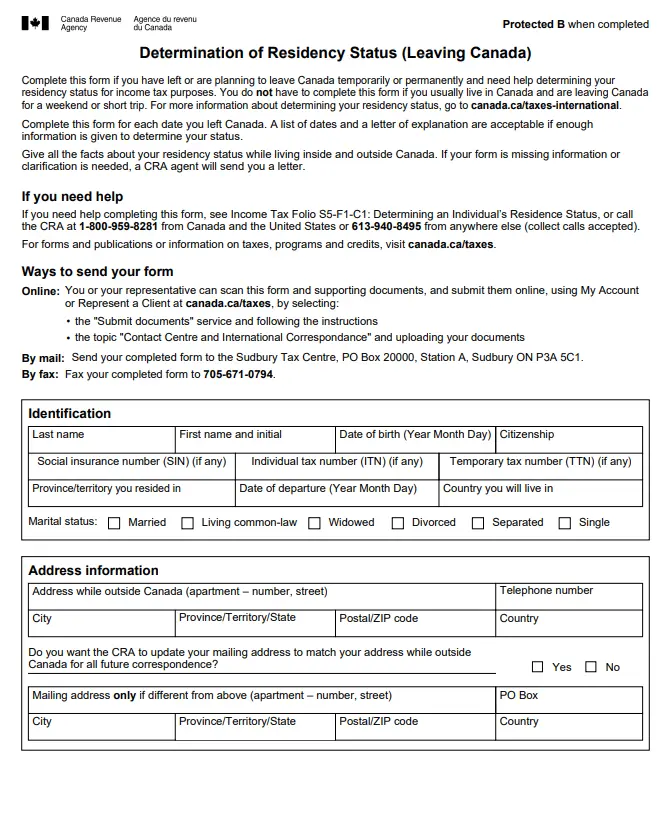
The NR73 Determination of Residency Status is a form submitted to the Canada Revenue Agency to get an official ruling on whether a person is a Canadian resident or non-resident for tax purposes. CRA reviews your residential ties, your departure date, and your connections to Canada before issuing a written determination. This ruling directly affects which tax returns you must file, what income you report, and what withholding rates apply to your Canadian income.
For anyone leaving Canada permanently, returning after years abroad, or unsure of their tax status, the NR73 provides legal clarity that protects you from filing the wrong return and paying the wrong amount of tax.
What Is the NR73 Form and Why Does It Matter?
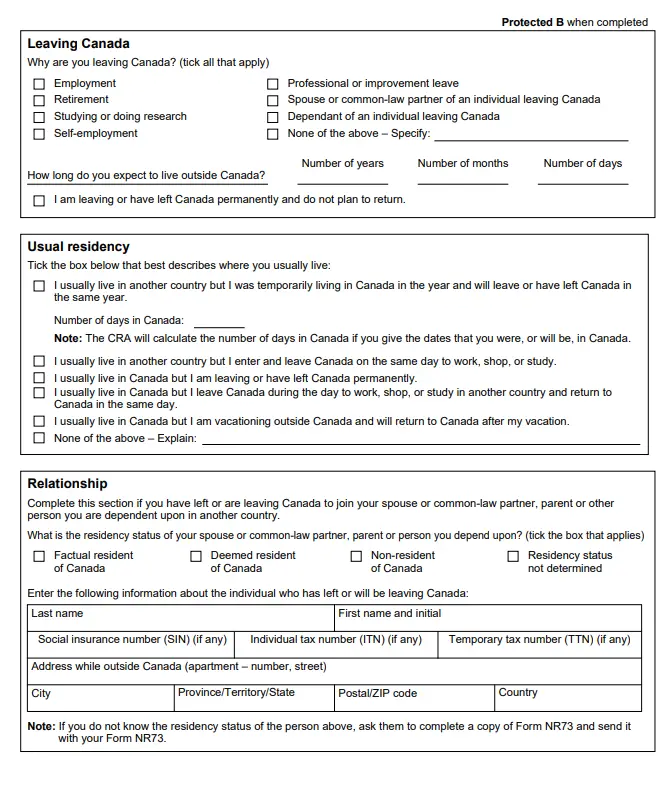
The NR73 is a CRA form titled Determination of Residency Status (Leaving Canada). It asks detailed questions about your residential ties to Canada including your home, spouse, dependants, bank accounts, driver’s licence, health card, and social memberships. CRA uses your answers to determine whether you severed enough ties to be considered a non-resident on your departure date or whether you remain a factual resident despite living outside Canada.
The determination matters because Canadian residents pay tax on their worldwide income while non-residents pay tax only on Canadian-source income at the applicable withholding rates. Getting this wrong in either direction costs real money. A person who should be a non-resident but files as a resident overpays tax on foreign income for years. A person who should still be a resident but files as a non-resident underpays and faces arrears interest at CRA’s prescribed rate of 9% annually plus potential penalties.
Who Should File the NR73?
Not everyone needs to file an NR73. CRA does not require it and it is entirely voluntary. The form is useful when your situation is genuinely unclear and the financial consequences of getting it wrong are significant.
The most common situations where filing an NR73 makes sense include people who left Canada but kept significant ties such as a family home, a spouse who stayed behind, or provincial health coverage still in force. It also applies to people who split time between Canada and another country without a clear break in residency, people returning to Canada after years abroad who want to confirm when their Canadian residency resumed, and dual citizens with ties to both Canada and the United States who are uncertain which country has primary tax rights under the Canada US Tax Treaty.
People who clearly severed all ties on a specific date, sold their home, moved their family, closed their accounts, and surrendered their provincial health card generally do not need the NR73 because their departure date is established and the non-resident status is not in question.
How CRA Determines Your Residency Status?
CRA applies the concept of residential ties when reviewing an NR73 submission. Ties are divided into two categories: primary ties and secondary ties.
Primary ties carry the most weight. They include a home available for your use in Canada, a spouse or common-law partner remaining in Canada, and dependants remaining in Canada. If any primary tie remains intact after your departure date, CRA is unlikely to grant non-resident status unless your circumstances are exceptional.
Secondary ties carry less weight individually but accumulate. They include Canadian bank accounts, credit cards, a driver’s licence, a Canadian passport, provincial health insurance, RRSPs not deregistered, investments in Canadian companies, and social or professional memberships. No single secondary tie automatically makes you a resident, but several together can tip CRA’s determination toward continued residency.
| Tie Type | Examples | Weight |
|---|---|---|
| Primary | Home in Canada, spouse, dependants | High, often decisive |
| Secondary | Bank accounts, driver’s licence, health card, RRSP | Accumulative |
| Other | Seasonal property, Canadian vehicle, club memberships | Low individually |
What Happens After You Submit the NR73?
CRA reviews the form and issues a written determination letter confirming your residency status and the date it takes effect. This letter is not legally binding in the same way a court ruling is, but it is CRA’s official position on your status and provides strong protection in the event of an audit or reassessment.
The determination affects several other filings. If CRA confirms non-resident status from a specific date, you need to file a Departure Tax Return for the year you left Canada, reporting deemed disposition gains on most of your worldwide assets as of that date. Our blog on Deemed Disposition Canada explains exactly which assets are caught by this rule and which exemptions apply before you reach your departure date.
Non-residents confirmed by CRA also become subject to Part XIII withholding tax at 25% on Canadian rental income, dividends, and pension payments unless a tax treaty reduces that rate. If you earn rental income from a Canadian property after becoming a non-resident, the CRA NR6 Form allows you to reduce that withholding from 25% of gross rent to 25% of net income, which makes a significant difference to your monthly cash flow.
For non-residents who eventually sell Canadian property, the CRA determination letter reinforces your non-resident status and confirms that the How to Get Certificate of Compliance process under Section 116 applies to your property sale. Our blog on T2062 and T2062A breaks down which form covers real estate versus other taxable Canadian property so you file correctly.
NR73 vs NR74: Which Form Applies to You?
Many people confuse the NR73 with the NR74. They serve opposite purposes.
| Form | Purpose | Who Files It |
|---|---|---|
| NR73 | Determination of residency for person leaving Canada | Canadians departing Canada |
| NR74 | Determination of residency for person entering Canada | Non-residents arriving in Canada |
If you left Canada and want CRA to confirm you are a non-resident, the NR73 applies. If you moved to Canada from another country and want CRA to confirm when your Canadian residency began, the NR74 applies. Filing the wrong form delays the process and requires resubmission with the correct form.
How Residency Status Affects Cross-Border Filers?
Residency determination has direct consequences for people with ties to both Canada and the United States. Under the Canada US Tax Treaty, residence is determined using a tie-breaker test that looks at permanent home, centre of vital interests, habitual abode, and nationality in that order. A person who qualifies as a resident of both countries under domestic law uses this treaty test to establish which country has primary taxing rights.
For US citizens living in Canada who hold a Tax-Free Savings Account, the residency question matters because the IRS does not recognize the TFSA as a tax-exempt account. Our blog on TFSA for US Citizens in Canada explains why this creates a reporting problem that many dual filers miss entirely. Similarly, taxes paid to a foreign government after a residency determination may generate a T2209 Foreign Tax Credit on your Canadian return, which prevents double taxation on the same income.
Conclusion
The NR73 Determination of Residency Status is one of the most important forms a departing Canadian can file, not because it is required, but because the consequences of getting residency wrong flow through every return you file for years afterward. Your departure date, your deemed disposition gains, your withholding rates, and your treaty positions all depend on whether CRA considers you a resident or a non-resident.
Tax Return Filers PC works with Canadians leaving the country, returning residents, and dual citizens across all provinces to handle Departure Tax Return filings in Toronto, Non-Resident Tax Filing in Calgary, Certificate of Compliance in Mississauga, and cross-border tax planning in Ottawa, ensuring your residency status is established correctly before any returns are filed.
FAQs
Book a Free Meeting with Our Tax Experts
Take the first step toward better tax planning with a free consultation. Our team is ready to review your situation and provide clear guidance. Book a time slot directly on our calendar and we will connect with you shortly.