RRSP Contribution Deadline in Canada: Dates, Limits, and Rules
The RRSP contribution deadline in Canada is March 1, 2027 for the 2026 tax year. You get the full calendar year plus the first 60 days of the next one, so money deposited by that date lowers your 2026 taxable income. Your limit for 2026 is 18 percent of your 2025 earned income, up to $33,810, minus any pension adjustment. Unused room carries forward with no expiry date. If you miss the deadline, the contribution still counts, just against the following tax year instead.
This guide covers the dates, the limits, the penalty for going over, and the age when contributions have to stop.
When Is the RRSP Contribution Deadline in Canada?
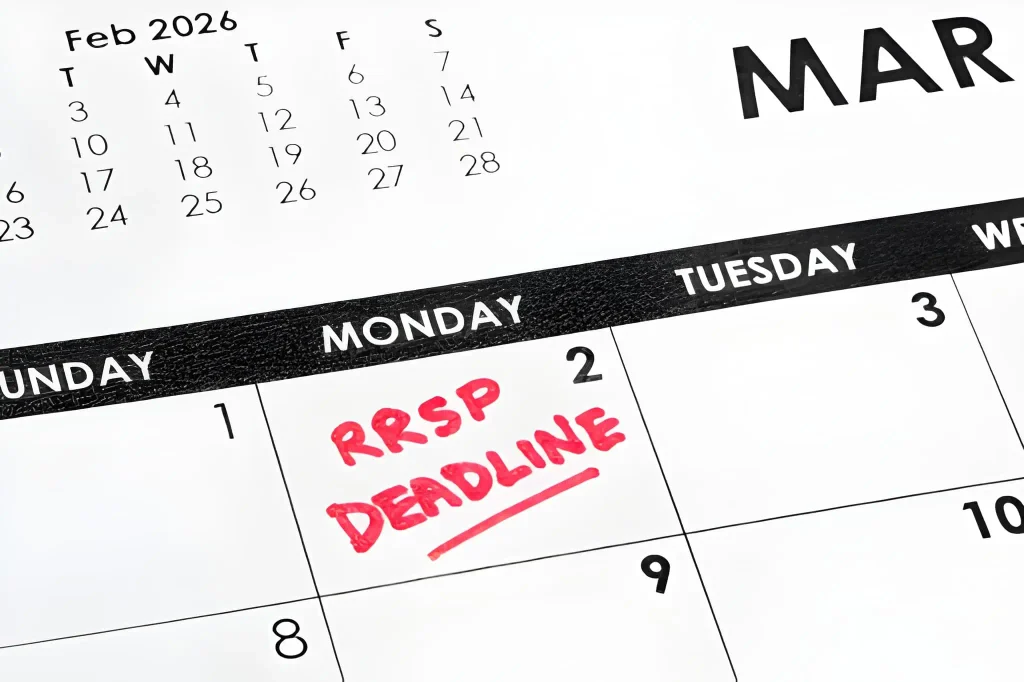
The deadline falls 60 days after the tax year ends. For the 2026 tax year, that date is March 1, 2027, and the money has to be in the account by 11:59 p.m. For the 2025 tax year, the deadline was March 2, 2026, because March 1 landed on a Sunday. CRA pushes the date to the next business day when the 60th day falls on a weekend.
That 60 day window is why banks and credit unions get busy every February. A contribution made on February 20, 2027 can be claimed on your 2026 return, even though the calendar already says 2027. The deadline has nothing to do with your filing date. Your T1 return is due April 30, but the contribution has to be made almost two months earlier. Our step by step guide to personal tax returns in Canada walks through the rest of the filing calendar.
RRSP Contribution Limits for 2026
Your limit is 18 percent of the earned income you reported in 2025, capped at $33,810 for 2026. Earned income covers employment income, self employment income, and net rental income. It does not include dividends, capital gains, or most pension income. If you earned $100,000 in 2025, your new room for 2026 is $18,000, since 18 percent sits below the dollar cap.
Members of a workplace pension plan get less new room. Box 52 of your T4 slip shows the pension adjustment, and CRA subtracts that amount from your limit. A $6,000 pension adjustment on $18,000 of new room leaves $12,000. The exact figure sits on your Notice of Assessment under “RRSP Deduction Limit,” and CRA My Account shows the same number. Never guess it. The number there already includes every dollar of unused room carried forward from past years, which is why many people have far more space than one year of income suggests.
How the First 60 Day Rule Works?
Contributions made between January 1 and March 1, 2027 belong to a special reporting period, and you report them on Schedule 7 with your 2026 return. You choose which year to claim the deduction.
You can also contribute now and deduct later. A contribution made in 2026 while you earn $55,000 can sit undeducted until 2028, when a promotion pushes you to $95,000 and a higher marginal rate. The money grows tax sheltered the whole time. The deduction is worth more in the higher income year, which is the same logic behind most moves in our guide on how to reduce your year end tax bill in Canada.
The RRSP deduction reduces the net income figure on line 15000 of your tax return, which also drives income tested benefits like the Canada Child Benefit and the GST/HST credit.
RRSP Deadlines and Limits at a Glance
The table below shows the numbers for the last three tax years.
| Tax Year | Contribution Deadline | Dollar Limit | Based On Earned Income From |
|---|---|---|---|
| 2024 | March 3, 2025 | $31,560 | 2023 |
| 2025 | March 2, 2026 | $32,490 | 2024 |
| 2026 | March 1, 2027 | $33,810 | 2025 |
Rules That Change Your RRSP Deadline
Three situations shift how the deadline and the limit apply to you.
1. Spousal RRSP Contributions
A spousal RRSP uses your contribution room but goes into an account owned by your spouse or common law partner, and the same March 1 deadline applies. You claim the deduction, and your spouse pays the tax on withdrawal at their lower rate.
The attribution rule matters here. If your spouse withdraws money within three calendar years of any spousal contribution, CRA taxes that amount back on your return rather than theirs.
2. The Year You Turn 71
Anyone who turns 71 during the year loses the 60 day extension. Your RRSP has to be closed, converted to a RRIF, or used to buy an annuity by December 31 of that year, so the final contribution deadline is December 31, not March 1. One exception exists for high earners.
A deliberate over contribution in December of that year gets absorbed by the new room that opens on January 1, and the 1 percent penalty applies for a single month only.
3. Withdrawals Under the HBP and LLP
Money pulled out under the Home Buyers’ Plan or the Lifelong Learning Plan comes out tax free, but repayments follow their own schedule. The HBP allows up to $60,000 per person and gives you 15 years to repay, starting the second year after withdrawal.
Repayments count against the same March 1 deadline, and a missed repayment gets added to your income for that year.
What Happens If You Miss the RRSP Contribution Deadline?
Nothing is lost permanently. Contribution room never expires, so unused space follows you forever and the money you deposit on March 2 simply applies to the next tax year. The real cost is the wait. A $15,000 contribution missed by one day delays roughly $6,000 of refund by a full twelve months at a 40 percent marginal rate.
The bigger risk sits on the other side of the line. Contributions over your limit trigger a penalty of 1 percent per month on the excess above a $2,000 lifetime cushion. You report the excess on Form T1-OVP within 90 days of the year end, and CRA charges interest on the penalty itself if it goes unpaid. The cushion is not extra room and you never get a deduction for it.
People who hold a workplace pension slip past their limit most often, because the pension adjustment arrives on the T4 in February after the contribution is already made. Anyone who runs their own payroll should check the pension adjustment before contributing, and our guide on payroll deductions in Canada explains where that number comes from.
Plan Your RRSP Contribution Before March 1
The RRSP contribution deadline in Canada rewards people who plan early instead of rushing in late February. Check your Notice of Assessment for the real limit, subtract the pension adjustment, and set up a monthly transfer so the deposit happens without a last minute scramble. Long term holders should also know what happens to your RRSP when you die in Canada, since the full balance becomes income on the final return unless it rolls over to a spouse. US citizens living in Canada face a separate reporting layer, covered in our guide on RRSP US tax reporting.
Tax Return Filers PC helps clients with personal income tax in Mississauga and estate planning in Toronto, so every contribution gets claimed in the right year and no deduction gets wasted. Clients in Alberta get the same review through personal income tax in Calgary, where a lower provincial rate changes how much a deduction is worth.
FAQs
Book a Free Meeting with Our Tax Experts
Take the first step toward better tax planning with a free consultation. Our team is ready to review your situation and provide clear guidance. Book a time slot directly on our calendar and we will connect with you shortly.